
Jenene.
Jenene came to Piha for the view, but stayed for the stillness, community, and perspective it brought to my life.
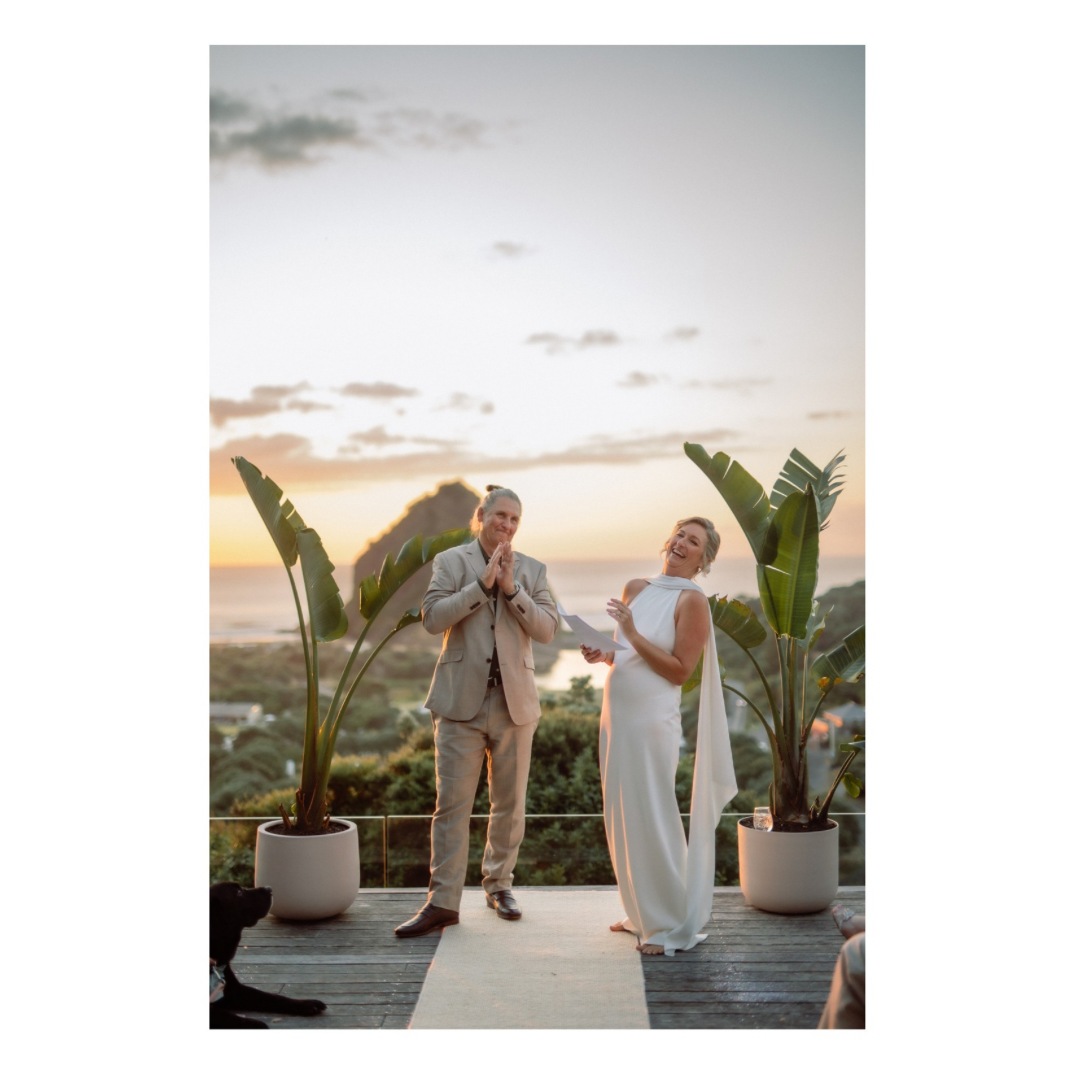
Jenene & Scottie got married at their home in February 2025, with a backdrop of Lion Rock.
We arrived in Piha on a leap of faith, drawn initially by the landscape and a renovation project overlooking the coast. What I found was something far deeper: community, stillness, creativity, and a completely different rhythm of life. We asked her five questions.
How long have you lived in Piha, and what first brought you here?
We moved to Piha nearly six years ago without really knowing what we were stepping into. Neither of us had spent any meaningful time here before, so in many ways it was a huge risk (and some people told us as much too!) We bought an old property overlooking the coastline, that was huge, needed a lot of love and slowly renovated it over time. What started as a project to bring us back to each other ended up completely changing the way we live. I guess you could say it was successful! Piha has a way of getting under your skin - the landscape is extraordinary, but it’s actually the community and sense of living with family that has surprised us the most.
What do you do for work (or how do you spend your days)?
I’ve spent most of my career building technology and consumer businesses, particularly in the beauty and wellness space. These days my work sits across governance, strategy, AI, writing, advocacy, and creative projects. Living in Piha has also unexpectedly reignited a love of photography for me - it’s become a way to slow down and really observe the environment around me. Outside of work, life here naturally pulls you into nature more. There’s a lot of walking, sea watching, weather watching, and chats with locals over coffee.
What’s something about Piha that surprises people once they actually spend time here?
I think people are often surprised by how soft and connected it feels. From the outside, Piha is often portrayed through dramatic headlines — rough surf, isolation, weather, tragedy — but the lived reality is very different. There’s an extraordinary sense of manaakitanga here. People genuinely look after each other. You see it in the small rituals: everyone waving the school kids onto the bus in the morning, neighbours checking in with each other, passerby chat at the store or bowler. It feels less like a suburb and more like a village with a very strong collective spirit.
What’s your favourite thing to do in Piha?
Honestly, just walking. Some days it’s the beach, some days it’s through the bush tracks or up around Mercer Bay with a camera. Piha changes constantly depending on the light, tides, cloud cover, and weather, so it never really looks the same twice. I love those moments where everything suddenly goes still - watching surfers from the shoreline, seeing sea fog roll through the valley, or catching the sunset turn the whole coastline gold or bright red. They’re different every time.
What do you love most about living here?
The feeling that life is a little more real here. We don’t have status anxiety. We don’t talk about jobs or anything that you might find in the city. There’s a simplicity and honesty to Piha that can be hard to find elsewhere. For us, it’s become a place of restoration - somewhere that creates space to think more clearly, connect more deeply, and live a little slower.
